
I didn’t grow up riding the bus. Where I grew up, there were no buses besides the nightmarish yellow school bus, which played a large part in the damaged psyches of an entire generation of kids (including me). I could write a whole novel about things I saw (and wished I could unsee) from my hours on that yellow school bus as a child. At one point on our bus, there was even a medical emergency that involved two middle school kids and a set of drumsticks. Not the chicken kind. If you really want to know, I’ll tell you over beers. The story is not fit for print.
After I moved to Washington, DC, I quickly learned the many mysterious rules of public transportation. The first rule I learned is that the side of the street (or metro track) you stand on matters greatly to your destination. There’s nothing more awkward than riding the bus in the wrong direction and having to stay on it until it completes its entire route to get you to the location you were hoping to reach in the first place. I still remember the driver’s pitying glances in the mirror, directed at me, as I learned the DC bus rules in front of an audience of one. However, once I mastered the directional rules, payment rules, and timing, I became a public transport super fan.
Last year in Abidjan was rough from a transportation perspective because the Yango cab was my only real option. Sitting in someone else’s pile of sweat is nobody’s idea of a good time, but I wouldn’t complain about it, since the other transportation options were even worse.
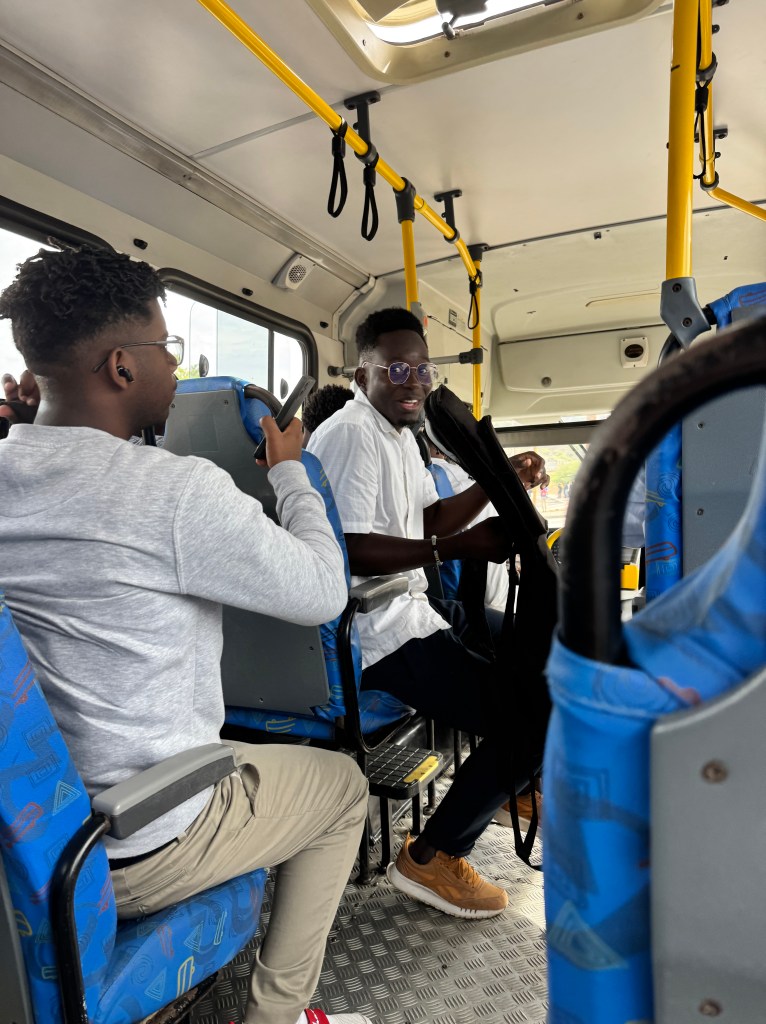
This year, I was immediately delighted to learn that there are reliable buses here. They even have numbers on them, published routes, and an app for the transportation company. Yay!
I started taking the bus the first week I arrived, and although my past experience with buses was helpful, I learned that there are a bunch of new bus rules I need to know.
Bus Rule #1: Be Aggressive
There are not enough bus drivers here because many of them seek other opportunities in Portugal (or other Western European countries), so there are fewer buses in operation than needed. As a result, buses are often overcrowded. When I say overcrowded, I mean loaded 50% beyond maximum capacity. When this happens, the last people have to stand in the stairwell on the loading steps in front of the payment turnstile. And when I say “people,” I occasionally mean me. Since the buses are all manual transmission, there is a lot of lurching and jerking, and when your head is very close to the windshield of a lurching and jerking bus, you pray for either a long life or a swift and painless death.
Cabo Verdeans are very polite. Except for in the bus line when all the elbows come out. Although I am a kind person, I am all elbows in that line. There is no guarantee of respect in the bus line, and niceties vanish. One time, I was so scrappy in that line that I accidentally hooked a woman’s bracelet to my umbrella, which was sticking out of the water bottle pocket on my backpack. I didn’t even notice until I was fully seated on the bus, and the poor young woman had to try to retrieve her bracelet. Don’t mess with Stephie T.
Bus Rule #2: Sauntering is Acceptable
Unlike in the US, where you signal to the bus driver to stop, the drivers here stop at every stop on the route, no matter what. This means two things: 1) the routes are less efficient because the bus stops everywhere, and 2) you don’t need to run to be at a stop for the bus driver to see you if you are getting on. Nobody seems to be in a hurry here, so when they see the bus approaching, they start to walk unhurriedly in the direction of the bus stop. As you can imagine, efficiency is the enemy of the sauntering masses.
Bus Rule #3: On at Front/Off at Back
Unlike in the US, bus riders move in one direction on the bus. You get on at the front and exit at the back. The only exception to this rule is if you are in the death zone near the windshield, then you get a pass to exit the bus at the front, mainly because you were barely on the bus in the first place.
Bus Rule #4: Hold on to Your Receipt
Very occasionally, without warning, a person will appear on the bus and ask you for your receipt. You’d better have it.
Bus Rule #5: Don’t Stand in the Sun
Usually, while waiting for the bus, people stand near the bus stop. Here that is not the case. Here, you prioritize shade above all else. If the bus stop is in the sun, you find a close-ish shady spot, and you wait there. Then, when you see the bus approaching, you start your saunter.
Bus Rule #6: Sit Near the Back, Always
Since the buses are often infrequent and overcrowded, you must sit near the back if you ever want to get off the bus. Since they only unload from the rear, it is very common for your delightful seat near the front to turn into a sardine-can nightmare when you need to disembark. As you frantically look up expletives like “Wait,” “Stop,” and “Help” on your translator app, the bus cruises by your planned exit point with you stuck on board like Charlie on the MTA. I’ve learned that you need just as many elbows to get off the bus as to get on it, so do yourself a favor and place your body as close to the back door as possible.
Bus Rule #7: The App is Merely a Suggestion
When I arrived, I thought it was great that there was a phone app for the bus, and that it tracked buses in real time. Womp, womp (cue the sad trombone).
It turns out the app is merely a suggestion of the schedule, and since there is a bus driver shortage, the buses’ regularity is unpredictable. It still beats a sweaty Yango any day.
Now that I know the bus rules, I’m a very pasty local with a lot of elbows and a sauntering attitude.
Buses rule!










Your bus might also be lurching because there is a cow walking through the center of town. Stay safe out there.
 On Another Continent
Leave a comment